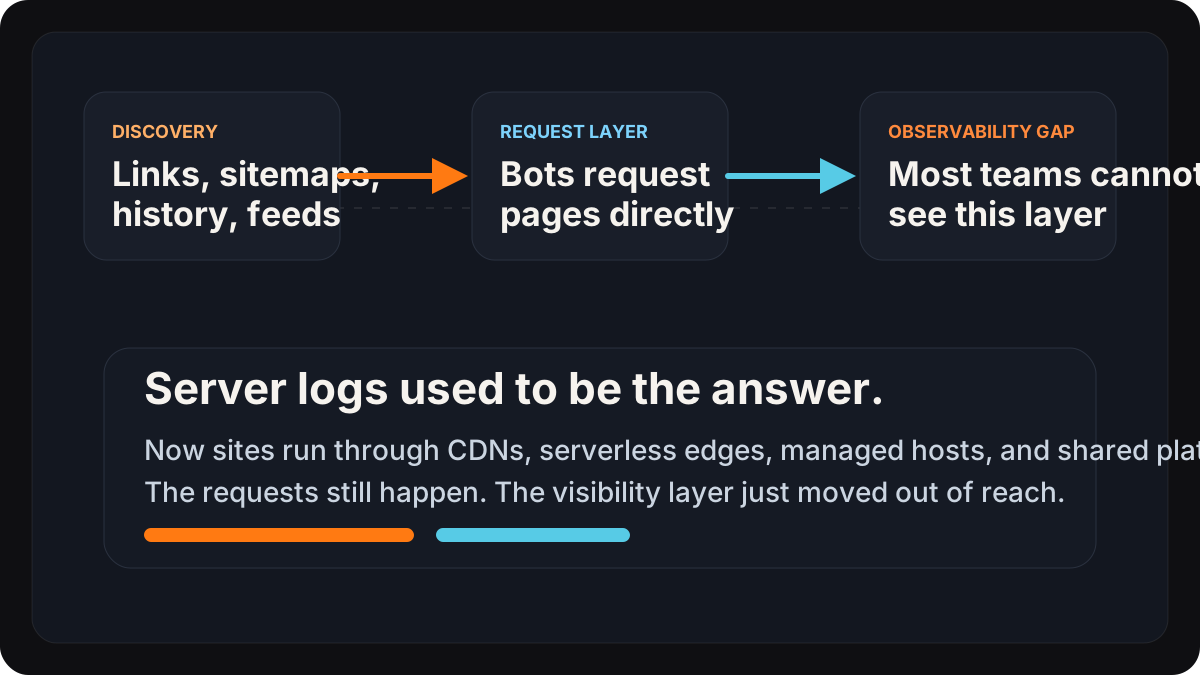
How bots actually find pages
Most crawlers arrive with context. They find URLs through internal links, XML sitemaps, feeds, canonical chains, previous crawl history, referrers, and external links from other sites. That means a bot visit is rarely random. It is usually the next move in a system that is already building a map of your website.
That matters because discovery patterns tell you something about visibility and architecture at the same time. If a section is never revisited, that can point to weak link pathways or weak demand. If another section gets revisited constantly, that can point to freshness, authority, or machine usefulness.
What a bot visit really is
A bot visit is not the same as a session, a pageview, or a human analytics event. It is a request. In the cleanest model, it is simply a machine asking for a URL at a specific time from a specific source with a specific user-agent string. That is why traditional analytics tools often struggle here. They were built to understand browser behavior, not request behavior.
Once you shift into that mental model, the whole product category gets clearer. You are not trying to recreate web analytics. You are trying to observe a thin slice of request traffic that reveals how automated systems interact with your content surface.
Different bots have different motives
Not all bots are showing up for the same reason. Search bots, AI crawlers, SEO tools, uptime monitors, performance scanners, and opportunistic scrapers may all touch the same site but produce very different patterns. If you collapse them into one bucket, the signal gets muddy fast.
Search crawlers
They care about discovery, refresh cycles, canonical structure, and indexability. Their revisit pattern often reflects how important or fresh a section appears.
AI crawlers
They can reveal where machine attention is forming first, especially around explainers, docs, product pages, and structured content.
SEO and competitive crawlers
These often crawl widely and aggressively, which can make them useful for visibility analysis but noisy if you mix them with search-engine behavior.
Spoofed or suspicious bots
These matter because they can imitate trusted bot names and distort the story unless you separate claimed identity from verified identity.
Why server logs became the default answer
For years, the standard advice was “check your server logs.” That advice was not wrong. Logs live at the request layer, which is exactly where crawler activity happens. If you had direct access to your origin and a clean way to process those files, logs could absolutely answer the question.
But the old advice assumed a simpler infrastructure model. It assumed one team controlled the server, one file captured the requests, and someone nearby could parse the data. In that world, logs were the obvious source of truth.
Why this became painful in modern stacks
Modern websites rarely live in one simple server context. They run behind CDNs, managed hosts, edge platforms, serverless functions, storefront platforms, shared hosting layers, reverse proxies, and product teams that do not control raw request infrastructure. The request still happens, but the visibility layer moved out of the hands of the person who needs the answer.
That creates a familiar gap:
- Marketing or SEO wants to know when Googlebot touched a section.
- Engineering does not want to hand over giant raw logs or build a special parser.
- Security and privacy teams do not want more request data copied around than necessary.
- The end result is that nobody gets a fast answer, even though the data technically exists somewhere.
This is why the crawler-visibility problem feels newer than it really is. The requests did not disappear. The easy path to seeing them did.
Why the pattern matters more than the count
A single bot hit can be interesting, but repeated patterns are where understanding begins. Which directories get revisited first? Which pages get bursts of attention after a launch? Which URLs receive only one touch and then disappear? Which bot families tend to cluster around your educational content versus your product content?
That is why page-level visibility matters so much. A domain-wide total hides the actual shape of the demand. The useful questions are directional:
- Where is crawl attention concentrating?
- What changed before the pattern shifted?
- Are search bots, AI bots, and tool crawlers behaving differently on the same surface?
How CrawlerLogs changes the model
CrawlerLogs takes the narrow part of server logs that teams actually need for this question and turns it into a product surface. Instead of shipping around full raw request files, the Worker path extracts four fields at the edge: URL, IP, user-agent, and timestamp. That is enough to classify, verify, and trend bot behavior without dragging the entire request log problem into the workflow.
And when the Worker path is not possible, the JavaScript tracker still gives teams a practical fallback. It is not the same data quality, but it keeps the visibility problem from becoming a total dead end.